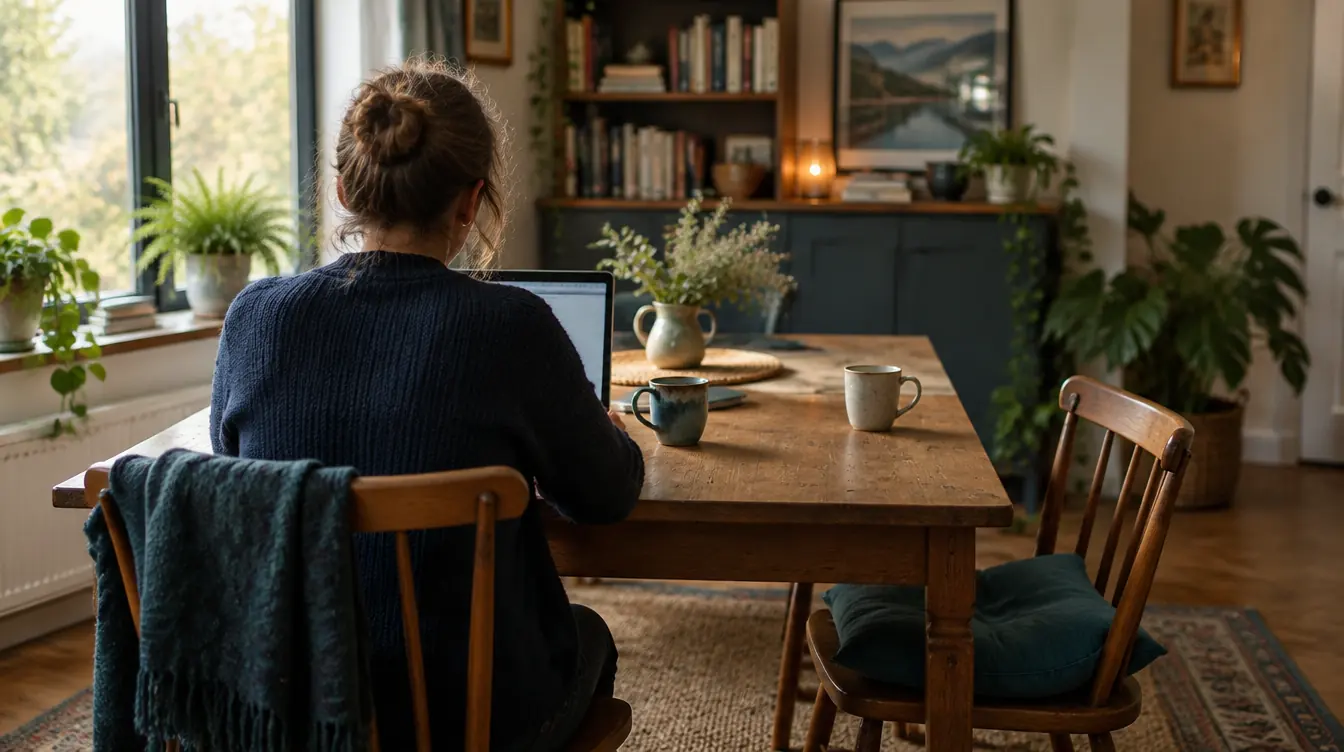
It started as a joke. Marieke leads a team at a mid-sized consultancy in Mechelen, and her weekly team meeting on Tuesday mornings always went the same way. Eight people round a table, laptops open, coffee in paper cups. After twenty minutes, the first eyes drifted to another screen. After forty, three people were still talking. She had tried everything: a tighter agenda, laptops closed, a timer. Each fix lasted a week or two.
Until Joris, the youngest on the team, said half in passing: "Why don't we do it walking?" Everyone laughed. Marieke too. But the following week, at ten o'clock, she was standing at the front door with her coat on.
The first time
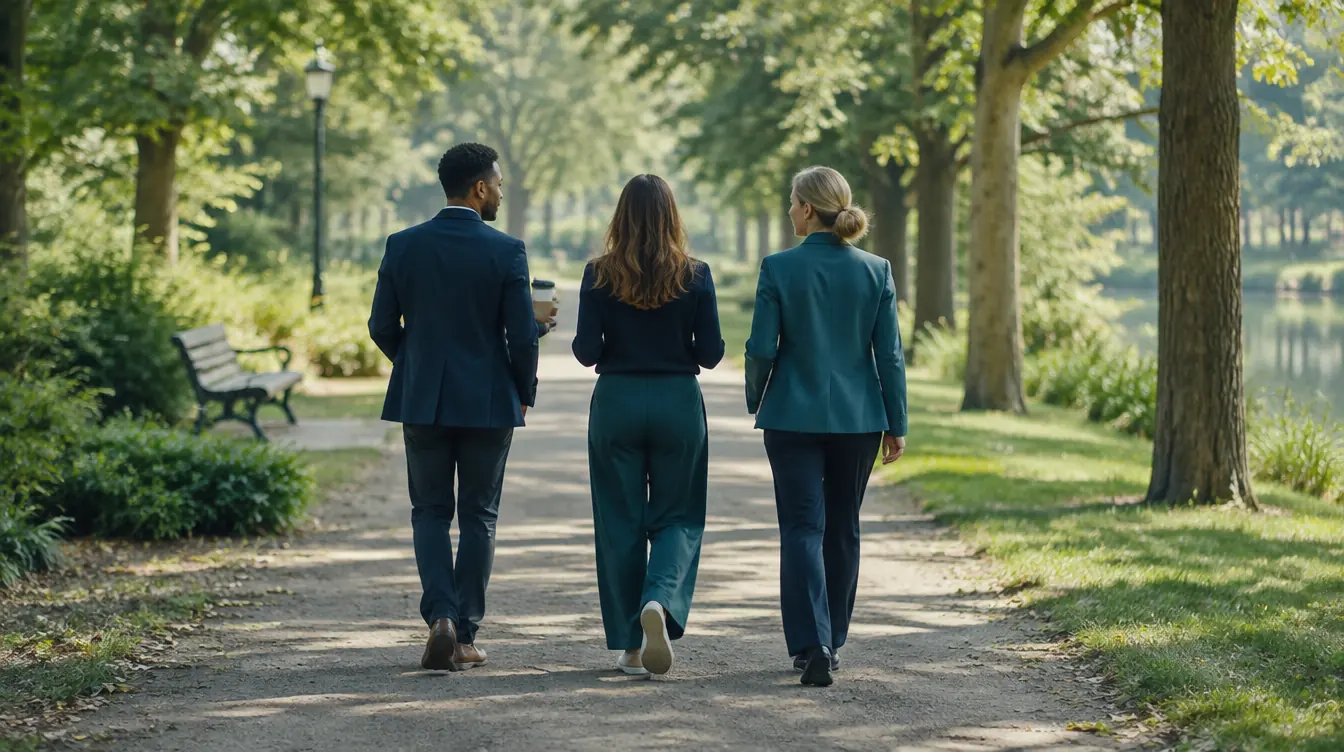
It felt awkward. Eight people walking along the river Dijle, some in coats too thin for the wind, others in shoes never meant for cobbles. No agenda on a screen, just three points Marieke had fixed in her head that morning. For the first quarter of an hour they moved in a huddle and half of them couldn't hear what the other half was saying.
Then something happened that nobody had foreseen. The group split naturally into twos and threes, and the conversations loosened up. Sofie, who rarely spoke in meetings, explained to Marieke on a narrow stretch of towpath why a client project had been stuck for weeks. "I'd never have said that at the table," she said later. "There it immediately sounds like a complaint."
Marieke thinks it has to do with the set-up. Walking beside someone is different from sitting opposite them. You are looking in the same direction, there is less eye contact, and silences aren't uncomfortable because you're walking anyway. That is her experience, not a law of nature. But she hears it from others too.
What changed
The team kept it up. Not every week: in rain or storms they stayed indoors, which in Belgium happens more often than you'd like. But often enough to make a habit of it. And there were consequences nobody had planned.
Meetings got shorter. A walk has a natural end: once you're back at the front door, it's over. What in a meeting room easily ran on to five past twelve was now wrapped up in three quarters of an hour. Decisions became more concrete, because there was no screen to hide behind and someone at the end simply asked: "So who's doing what?"
The content changed too. For the brainstorming part, fresh ideas for a client proposal, things seemed to go better outdoors. There is research on this. In a series of American experiments published in 2014, 81% of participants were more creative while walking than while sitting, on a test where you think up as many uses as possible for an everyday object. On tasks where you have to find a single correct answer, the effect was much smaller. So walking mainly helps to open up ideas, less to settle them.
And two colleagues who had known each other for years only by email, the accountant and a project manager from another office seconded to the team for a while, discovered they had both ridden with the same cycling club.
Ilias and his back
Ilias, one of the senior consultants, noticed something else. For months he'd had a stiff lower back, which he put down to his age and the drive in from Leuven. "I had no reason at all to think meetings had anything to do with it," he says. "Until after a few weeks I noticed I was less stiff on Tuesday evening than on Monday evening."
It's surely not the only explanation, he admits. But it got him counting. The car, the desk, the meeting room, the sofa in the evening. He ended up with more hours sitting than on his feet in his waking day.
He is not alone. According to Sciensano's Health Interview Survey 2023-2024, 58.7% of working Belgians aged 15 to 64 mostly sit or stand at work, without much walking or carrying. Among people with a higher education degree, it is 70.3%. Across the whole day, the population aged 15 and over spends an average of 5 hours and 56 minutes sitting or resting, and one in four (24.7%) does so for more than eight hours a day.
Because the complaints didn't fully go away, Ilias eventually had his back checked by his GP. That was sensible. One walk a week is not a treatment, and persistent back pain deserves a conversation with a doctor or physiotherapist.
Where it doesn't work
Marieke is wary of big conclusions. Some subjects simply need a table. Going through a budget, adjusting a schedule in Excel, a difficult performance review: you don't do those on a towpath. Confidential conversations don't belong on a busy pavement where a client might happen to cycle past either.
She also had to learn that not everyone walks as gladly or as easily. A colleague with a knee injury walked along in silence for the first few weeks and paid for it afterwards. Since then the arrangement has been clear: anyone who can't or doesn't want to join comes in for the second part indoors, or the team chooses a shorter, flat loop with a bench halfway.
She is not the only one to run into hurdles like these, as a Danish study of office workers from 2020 shows. Teams there could choose between standing and walking meetings. Standing meetings caught on and were associated with 59 minutes less sitting per eight-hour working day. Walking meetings barely got off the ground: people found them impractical and less efficient. A good idea on paper is not yet a habit. It takes a manager who champions it, and a format that fits the work.
How the team does it now
A year on, the team has found a fixed format. The meeting starts outside with the items about direction and ideas. There are at most three topics, posted in advance in the team chat. Afterwards someone records the agreements as a voice memo, so there is still a record. The loop takes thirty to thirty-five minutes and ends at the front door, where anyone who wants to sits down at a table for ten more minutes for whatever needs figures. If it rains, the meeting moves to Thursday. If it's still raining then, they meet indoors, but standing up.
"I only wanted to put some movement into our work," says Marieke. "I got a different way of talking to each other."
If you're thinking about your own sitting hours, there's no need to overhaul your whole working week. Sometimes it's enough to move one conversation a week: the catch-up with a colleague from another department, the client call you could just as well take with earphones in, the one-to-one with a team member. Start small and see what it does.
If you notice that workload or tension in your team is the real reason meetings feel stiff, a walk won't fix that. Talking it through with someone can help. Your employer may offer confidential support through Meapy Health, for staff and for managers alike.
Marieke, Ilias and their colleagues are fictional. Their story is put together from situations that often occur.
Sources
- Drieskens S., Janssens M., Van der Heyden J. (Sciensano), Gezondheidsenquête 2023-2024: Lichaamsbeweging (Health Interview Survey 2023-2024: Physical activity, report in Dutch), 2025. sciensano.be
- Oppezzo M., Schwartz D.L., Give your ideas some legs: the positive effect of walking on creative thinking, Journal of Experimental Psychology: Learning, Memory, and Cognition, 2014. doi.org/10.1037/a0036577
- Danquah I.H., Tolstrup J.S., Standing Meetings Are Feasible and Effective in Reducing Sitting Time among Office Workers, Walking Meetings Are Not, International Journal of Environmental Research and Public Health, 2020. doi.org/10.3390/ijerph17051713